Honey Journal
This Honey Made Me Realise I'd Never Had Proper Honey Before
4 min read · 31 Mar 2026
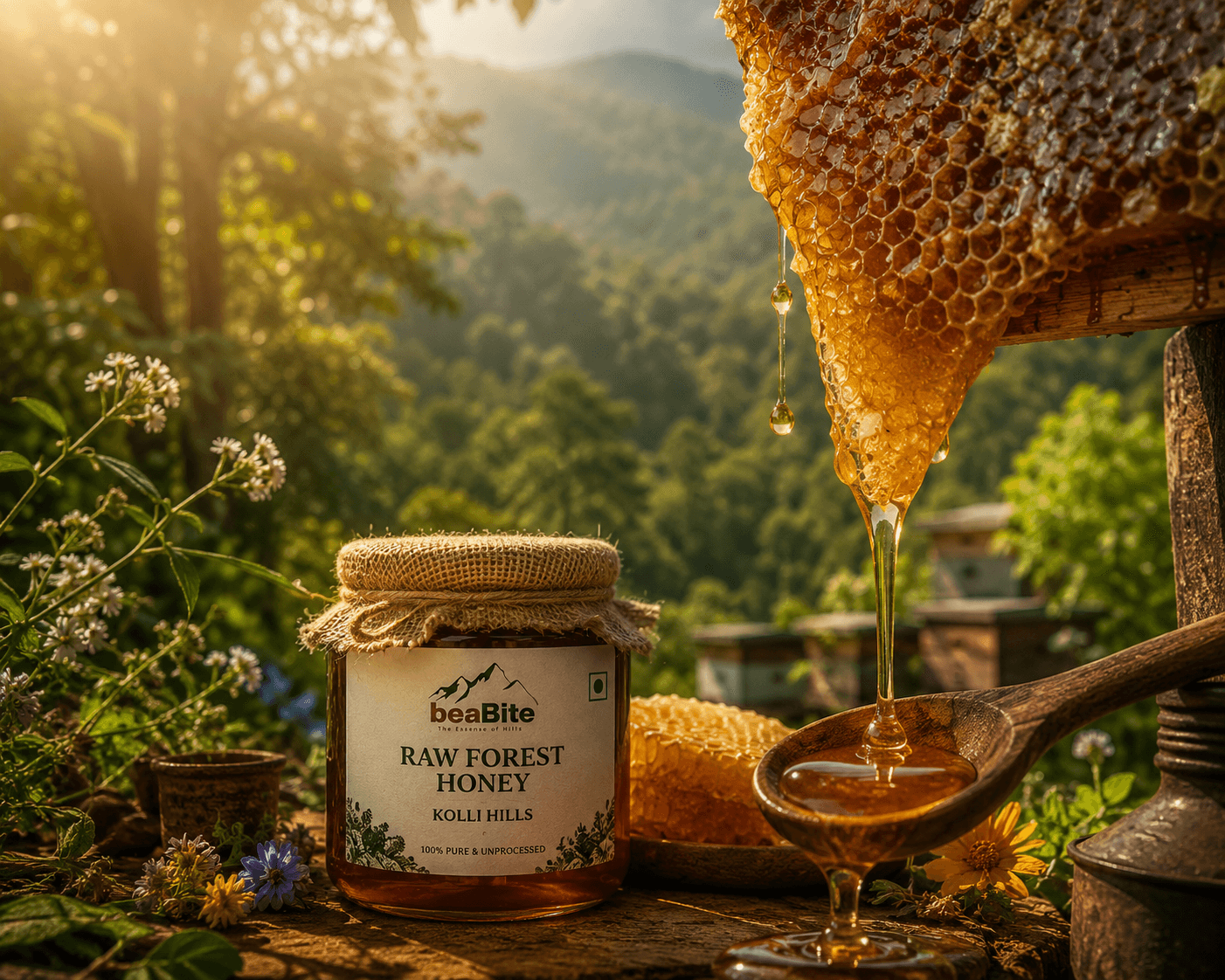
Raw honey is not a wellness trend. It's what honey actually is before it's heated, filtered, and standardised into something that lasts on a shelf for three years without changing. Wild forest honey from Kolli Hills is what happens when you skip all of that.
Story
Honey Journal
Reading time
4 min read
Published
31 Mar 2026
Section 01
What processing does to honey
Commercial honey is heated to flow faster through bottling lines and filtered to remove pollen. Both processes destroy enzymes, strip aroma compounds, and remove the things that give honey its character.
What you get is stable, predictable, and largely flavourless — a sweetener that happens to come from bees. What you lose is everything that made it interesting.
Section 02
What the bees forage matters more than anything
Honey tastes like the flowers the bees visit. In monoculture farming regions, bees forage on one or two crops, and the honey is simple. In the biodiverse forests of Kolli Hills, bees move through dozens of wild plants across a landscape that hasn't been cleared for agriculture.
The result is honey with layers — floral top notes, a wildness in the mid-palate, and a finish that lingers. You can taste the forest. That's not a metaphor.
Section 03
How it changes what you cook and drink
I used to use honey as a simple sweetener — a spoonful in tea, a drizzle on toast. Raw Kolli Hills honey changed how I think about it. In tea, it adds depth rather than just sweetness. Eaten straight from the spoon, it's genuinely interesting.
The texture is also different. Raw honey is thicker and more viscous. It may crystallise over time — a sign it's real and unprocessed, not a defect.
Section 04
Why the source matters for something you eat every day
Most pantry staples are bought without thinking. The problem is that familiar in the honey market usually means heavily processed, sometimes adulterated, and sourced from wherever is cheapest.
Kolli Hills honey costs more than the supermarket version. It also tastes like a specific place, harvested with care and handled minimally. The price gap is the gap between a commodity and the real thing.
Continue exploring
Raw forest honey, bottled the way it should be
Harvested from the biodiverse forests of Kolli Hills. Unheated, unfiltered, and tasting exactly like the landscape it came from.